
Video Production Services and Filming in Stuttgart, Germany: A Filmmaker’s Location Guide
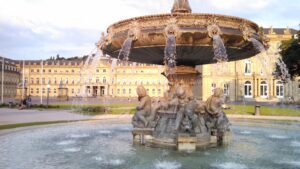 Stuttgart is one of Germany’s most underrated production destinations — a city of dramatic topography, architectural contrast, and a surrounding landscape that can double for half a dozen different worlds in a single shoot day. It is also an industrial hub for some of Germany’s largest and best known companies such as Bosch, Mercedes or Hugo Boss.
Nestled in a basin of vine-covered hills in the heart of Baden-Württemberg, Stuttgart has been quietly building a reputation among international productions seeking a European city that refuses to look like everywhere else. Where Berlin offers grit and Munich offers grandeur, Stuttgart offers something rarer: genuine visual variety within a compact, highly manageable geography. For documentary teams, commercial directors, and drama productions alike, that translates directly into schedule efficiency and creative flexibility.
The City: Architecture Across Every Era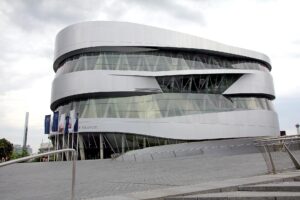
Stuttgart’s cityscape is an accidental film set. Post-war reconstruction, bold Modernist civic buildings, and ambitious contemporary architecture sit alongside preserved Wilhelminian residential streets and baroque palace grounds — all within walking distance of each other. The Schlossplatz, the city’s grand baroque centrepiece, flanked by the Königsbau and the Kunstmuseum’s luminous glass cube, gives productions a formal European elegance that reads beautifully on camera.
For urban grit and texture, the Nordbahnhof quarter and the industrial fringes near Bad Cannstatt offer weathered warehouse facades, old rail infrastructure, and working-class architecture that suit crime drama, music videos, and gritty commercial work. The elevated U-Bahn lines and Stuttgart’s famously steep funicular railways — the Standseilbahn and Zacke — are practically unique in German urban filmmaking, providing dynamic, kinetic transit sequences that are impossible to replicate elsewhere.
Stuttgart’s topography does what most cities can’t: it gives your frame multiple planes without any camera movement at all.
The Landscape: Hills, Vines & River Valley
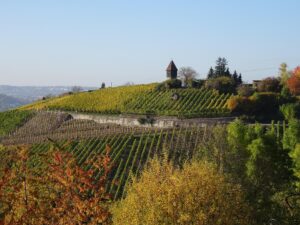 Step outside the city centre and Stuttgart’s surroundings open into a landscape of remarkable cinematic range. The Swabian wine country begins almost immediately at the city’s northern and eastern edges — terraced vineyards cascading down steep hillsides into the Neckar valley, producing imagery that sits somewhere between Burgundy and the Rhine gorge. These locations are consistently in demand for food and drink advertising, travel content, and European period drama.
The Neckar River itself provides strong location value: broad, calm water with forested banks, historic bridges, and access to medieval towns like Esslingen am Neckar just 15 minutes from the city. Esslingen’s preserved half-timbered old town and castle ruins have stood in for medieval Germany — and indeed medieval Europe — in numerous productions, offering a complete period environment within the Stuttgart metropolitan area.
The Automotive Dimension
No filming guide to Stuttgart is complete without acknowledging the city’s defining industrial identity. This is the home of both Mercedes-Benz and Porsche — and both manufacturers maintain world-class museums here that are, in themselves, extraordinary architectural filming locations. The Mercedes-Benz Museum’s double-helix ramp structure by UNStudio is one of the most photogenic interiors in Germany, while the Porsche Museum’s cantilevered white volume offers a very different kind of modernist drama. For automotive productions, test drives in the surrounding Black Forest and Swabian Alb roads add a route dimension that is genuinely hard to match anywhere in Central Europe.
Production Practicalities
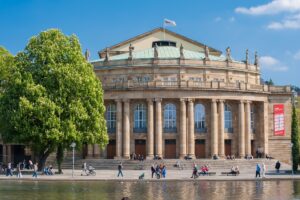 Stuttgart is served by Stuttgart Airport (STR) with direct connections across Europe and beyond. The city’s compact size means most key locations are reachable within 30 minutes — a significant advantage over larger German production centres. Baden-Württemberg’s film commission, MFG Filmförderung, actively supports inward productions and can assist with permits, location scouting, and regional co-production enquiries. The local crew base is experienced and well-connected, with strong technical infrastructure serving both broadcast and cinema-grade productions.
The climate rewards production planning: Baden-Württemberg is one of Germany’s warmest and sunniest regions, with the autumn harvest season — September through October — delivering golden light across the vineyards that is particularly prized by commercial directors and documentary cinematographers.
The Bottom Line
Stuttgart rewards the production that looks beyond the obvious German cities. Its combination of manageable scale, visual variety, world-class architectural landmarks, and a surrounding landscape of genuine cinematic power make it one of the most compelling mid-size production destinations in Central Europe. Whether you’re shooting a luxury automotive campaign, a European drama, a travel documentary, or a high-end commercial, Stuttgart will give your frames something different — and your production something unexpectedly efficient.
Planning a shoot in Stuttgart?
Camera Crew Germany provides experienced local crews, location scouting, and full production support across Baden-Württemberg and the wider Stuttgart region! Get in touch now and discuss your shoot with us.
Frequently Asked Questions About Filming in Stuttgart
Is Stuttgart a good location for film and video production?
Yes. Stuttgart is one of Germany’s most versatile filming locations, offering a mix of historic architecture, modern business districts, vineyards, forests, automotive landmarks and contemporary urban spaces. The city is particularly popular for corporate videos, documentaries, commercials, branded content and television productions. Its excellent transport links and experienced local production professionals also make it an efficient base for international productions.
Do I need a filming permit in Stuttgart?
It depends on your production. Small crews filming in public without disrupting pedestrians or traffic often require little or no formal permission. However, larger productions using professional equipment, road closures, drones, lighting setups or exclusive use of public spaces will usually need permits from the relevant authorities. Applications affecting public roads should generally be submitted at least two weeks before filming.
Can international production companies hire local film crews in Stuttgart?
Absolutely. Many international broadcasters, agencies and brands hire local English-speaking camera crews, producers, fixers, sound recordists and lighting technicians in Stuttgart. Working with a local production team reduces travel costs, simplifies logistics and provides valuable local knowledge when filming in Germany. Camera Crew Germany offers local crews and knowledge combined – our experienced local teams will support your production wherever they can.
Why hire a local production company for filming in Stuttgart?
A local production company can assist with location scouting, filming permits, bilingual crew, equipment rental, logistics, transport and production management. Local expertise helps productions save time, avoid common logistical challenges and ensure filming runs smoothly while complying with local regulations.
Can Camera Crew Germany provide filming support in Stuttgart?
Yes. Camera Crew Germany provides experienced English-speaking camera crews, producers, fixers, location managers and production services and sound recordists throughout Stuttgart and across Germany. Whether you need a single camera operator or a complete production crew, we help international clients film efficiently with local expertise and international production standards.
Call us now: +49 69 538690
or email us at info@cameracrewgermany.com
